
MARI® Practitioner Clinical Training: Approved Certification Pathway -Application
Write your awesome label here.
Apply today
-
Trainer: P. Gonzalez, LPC
Certified MARI® Teacher -
Audience: Behavioral Health Therapists
-
Level: Intermediate
Earn 25 CE Credits -
Asynchronous Learning: 18 Hours
-
Live Online Classroom:
5 Hours -
Live Online Supervision:
2 hours -
Approved Provider for
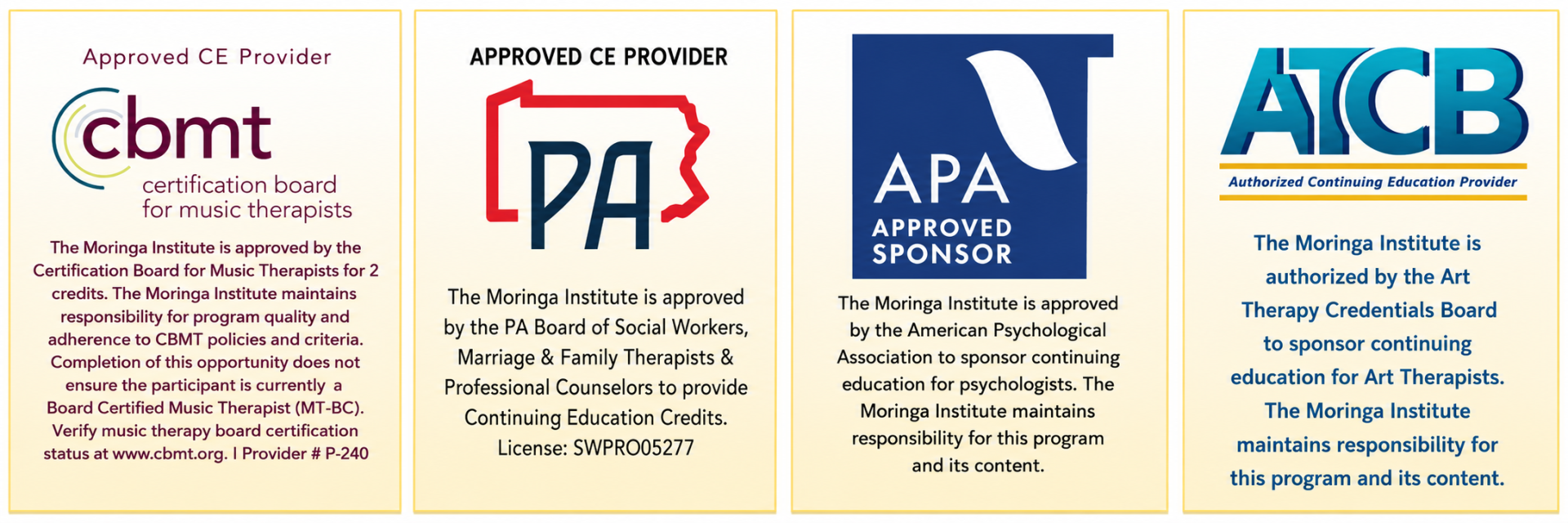
PA Board SW, MFT, & PC -
Approved Program by MARI Creative Resources, LLC
-
All-Inclusive Tuition:
$1,895.00 (includes materials)
Course overview
This Approved Clinical Certification Pathway Course, designed specifically for behavioral health professionals, prepares therapists to facilitate a powerful art-based process using the MARI® system. The training enhances therapists’ clinical competencies by introducing an advanced approach that fosters insight, mind-body integration, connection with self and others, attunement with the core self, and resiliency.
Certification Pathway
Participants complete the official requirements for MARI® Practitioner Certification through the only online blended program that integrates self-paced learning, live instruction, and guided clinical supervision.

Where Art Meets Therapy
This Approved Clinical Certification Pathway Course equips therapists to guide individuals through a transformative experience that transcends language. By drawing mandalas, selecting and pairing symbols with colors, and interpreting these expressions within the framework of life cycle stages, therapists help individuals explore and understand their inner world. This process often allows participants to:
- recognize their strengths and weaknesses,
- identify their struggles and accomplishments,
- connect with their authentic self, and
- discover internal resources that foster resiliency and wellness.
Write your awesome label here.
Historical Foundations
We will explore the historical roots of mandalas across diverse cultures to deepen cultural awareness and enhance inclusive, culturally informed therapeutic practice.
Archetype Application
We will rehearse integrating archetypal principles within the MARI® process to encourage therapeutic shifts and create stronger person-centered opportunities for growth.
Mapping the Psyche
We will learn how to use the MARI® process to visualize the psyche, assess needs, and provide effective support.
MARI® Card Test Implementation
We will explore how to administer the MARI® Card test within a life-cycle framework, emphasizing a strengths-based, positive psychological approach.
Tools & Resources
We will explore the MARI® process as both an assessment tool and a therapeutic intervention, and learn how to utilize MARI® resources to further enhance clinical practice.
Learning Objectives

- Describe the use of mandalas in at least one cultural context and its relevance to practice.
- Identify three ethical considerations and supporting factors that highlight how mandala creation can positively impact physical, mental, or spiritual well-being .
- Summarize Joan Kellogg’s development of the MARI® system, including its Jungian theoretical foundations, clinical relevance, and Michele Takei’s advancements to the framework.
- Describe the Continuum of Color and apply both individual and universal interpretations to create person-centered approaches that foster self-awareness.
- Analyze archetypal patterns and apply both light and shadow perspectives through a positive psychological lens.
- Describe how MARI's creative processes impact individual's daily functioning.
- Administer the MARI® card test and mandala creation as therapeutic tools to encourage self-exploration and meaningful insight.
- List three populations that benefit from MARI in clinical practice
Who Can Join the MARI® Practitioner Program?
Start your certification pathway
—
1
Apply
Fulfill application requirements, complete course registration, & pay full tuition.
2
Learn
Complete all asynchronous (on demand) classes and coursework by the designated deadline.
3
Attend
Attend all live online classes, remain visible on camera throughout each session, and participate fully.
4
Practice
Complete eight (8) case studies with participants who are not clients.
5
Supervision
Attend two hours of MARI® case-study supervision after completing class participation and case-studies.
6
Mastery
Demonstrate your expertise by passing all required exams
7
Certification
Upon course completion, Moringa supports the finalization of your certification—usually within one business day—at no extra cost, adding you to the international MARI® practitioner registry.
Life. Growth. Return. Renewal.
Curious about the essence of MARI? Appleseed, an original work by Patricia J. Gonzalez, brings the life cycle into motion. Inspired by Kellogg’s The Great Round, it unfolds through shifting seasons and time, revealing the rhythm of life—growth, return, and renewal.
Learning Schedule & Approved Provider Status
Course Schedule
Asynchronous Learning Content
Part 1: History of the Mandala (28 minutes)
Part 2: Birth of MARI® (14 minutes)
Part 3: How MARI® Works (27 minutes)
Part 4: MARI® in Practice (37 minutes)
Part 5: Introduction to Color and the MARI® Stages
Mandala Drawing Demo (6 minutes)
Synchronous Learning Content (Live Online)
BONUS - Behind the Practice: Interview with Dr. Takei Spring 2026 (60 minutes)
Part 1: History of the Mandala (28 minutes)
- Definition of mandala (circle; essence + container)
- Symbolism: wholeness, unity, cosmos
- Cultural uses (Buddhist, Christian, Indigenous traditions)
- Historical meaning and connection to the Self
- Jung’s contributions:
- Unconscious exploration
- Psychological integration
- Individuation
- Archetypes and symbols
Part 2: Birth of MARI® (14 minutes)
- Joan Kellogg and development of MARI®
- The Great Round (developmental framework)
- Mandala Card Test (symbols + colors)
- Growth as cyclical (spiral development)
Part 3: How MARI® Works (27 minutes)
- Experiential process (drawing + cards)
- Card test steps (likes, dislike, helpers, colors)
- Symbol = experience; Color = emotion
- Role of color and change color
- The Great Round (mapping the psyche)
- Michele Takei’s contributions to the MARI process
Part 4: MARI® in Practice (37 minutes)
- Integration with clinical approaches (EMDR, IFS, etc.)
- Clinical applications (trauma, expression, regulation)
- Training focus (archetypes, meaning, integration)
-
Research and evidence
Part 5: Introduction to Color and the MARI® Stages
- Introduction to Color
- Introduction to the Core
- Quadrant I: Forming (Stages 1, 2, &3)
- Quadrant II: Becoming (Stages 4, 5, 6)
- Quadrant III: Manifesting (Stages 7, 8, 9)
- Quadrant IV: Dissolving (Stages 10, 11, 12 & 1 Again)
Total 16 Hours
Mandala Drawing Demo (6 minutes)
- View the process of creating a mandala
- MARI® Experiential Foundations
Attend four classes designed to support the integration and application of course content.
Total: 4 hours - Individual Supervision
Complete two hours of individual supervision to review and evaluate MARI® case studies after completing all required classes and case-study assignments.
Total: 2 hours
BONUS - Behind the Practice: Interview with Dr. Takei Spring 2026 (60 minutes)
- Discover how Dr. Takei’s life experiences informed his revisions to Kellogg’s MARI®
- Hear directly from Dr. Takei how recent updates have enhanced the tool’s functionality
- Gain insight into Dr. Takei’s vision for the future of MARI®
Course References
Amelia, G., Satiadarma, M. P., & Wati, L. (2020, December). The effects of drawing and coloring mandala on anxiety among pregnant women in their third trimester. In The 2nd Tarumanagara International Conference on the Applications of Social Sciences and Humanities (TICASH 2020) (pp. 997–1002). Atlantis Press. https://doi.org/10.2991/assehr.k.201209.158
Bi, Y., & Liu, Y. (2019). Creating mandalas reduces social anxiety in college students. Social Behavior and Personality: An International Journal, 47(10). https://doi.org/10.2224/sbp.8410
Dahlke, R. & Pakinson, C. (1995). Mandalas of the world: A mediating & painting guide. Sterling Publishing Co., LLC NY.
Gonzalez, P. (2025). MARI® practitioner training program. [PowerPoint Slides]. Moringa Institute. Unpublished manuscript.
Gonzalez, P. J. (2011). The impact of music therapists’ music cultures on the development of their professional frameworks. Qualitative Inquiries in Music Therapy, 6, 1-33.
Bi, Y., & Liu, Y. (2019). Creating mandalas reduces social anxiety in college students. Social Behavior and Personality: An International Journal, 47(10). https://doi.org/10.2224/sbp.8410
Dahlke, R. & Pakinson, C. (1995). Mandalas of the world: A mediating & painting guide. Sterling Publishing Co., LLC NY.
Gonzalez, P. (2025). MARI® practitioner training program. [PowerPoint Slides]. Moringa Institute. Unpublished manuscript.
Gonzalez, P. J. (2011). The impact of music therapists’ music cultures on the development of their professional frameworks. Qualitative Inquiries in Music Therapy, 6, 1-33.
Kellogg, J. (2009). Mandala: Path to beauty. 3rd Printing. Publisher J. Kellogg, Clearwater, Fl.
Mo, Y. N., & Ko, K. S. (2023). International Chinese students’ experiences of participating in mandala-based art therapy in Korea: A phenomenological study. Frontiers in Psychology, 14, 1263754. https://doi.org/10.3389/fpsyg.2023.1263754
Potash, J. S., Chen, J. Y., & Tsang, J. P. (2016). Medical student mandala making for holistic well-being. Medical Humanities, 42(1), 17–25. https://doi.org/10.1136/medhum-2015-010717
Store, S. J., & Jakobsson, N. (2022). The effect of mandala coloring on state anxiety: A systematic review and meta-analysis. Art Therapy, 39(4), 173–181. https://doi.org/10.1080/07421656.2021.2003144
Mo, Y. N., & Ko, K. S. (2023). International Chinese students’ experiences of participating in mandala-based art therapy in Korea: A phenomenological study. Frontiers in Psychology, 14, 1263754. https://doi.org/10.3389/fpsyg.2023.1263754
Potash, J. S., Chen, J. Y., & Tsang, J. P. (2016). Medical student mandala making for holistic well-being. Medical Humanities, 42(1), 17–25. https://doi.org/10.1136/medhum-2015-010717
Store, S. J., & Jakobsson, N. (2022). The effect of mandala coloring on state anxiety: A systematic review and meta-analysis. Art Therapy, 39(4), 173–181. https://doi.org/10.1080/07421656.2021.2003144
Takei, M. (2019, October 23). What is MARI? -The mandala assessment research instrument. YouTube. https://www.youtube.com/watch?v=ykAThSI1dA8&t=243s
Takei, M. (2024). MARI®: Mandala assessment research instrument manual. MARI Creative Resources, LLC Raleigh, NC.
Takei, M., & Zikmund, J. (2024). MARI® practitioner training program. [PowerPoint Slides]. MARI Creative Resources, LLC Unpublished manuscript.
van der Vennet, R., & Cassella, C. (2020). Do mandalas exhibit archetypal patterns based on Kellogg’s MARI? A pilot study. Canadian Journal of Counselling and Psychotherapy, 54(3), 388–412.
Takei, M., & Zikmund, J. (2024). MARI® practitioner training program. [PowerPoint Slides]. MARI Creative Resources, LLC Unpublished manuscript.
van der Vennet, R., & Cassella, C. (2020). Do mandalas exhibit archetypal patterns based on Kellogg’s MARI? A pilot study. Canadian Journal of Counselling and Psychotherapy, 54(3), 388–412.
van der Vennet, R., & Ciancio, A. (2024). Art therapy graduate students’ mandalas based on Kellogg’s Great Round. Art Therapy, 41(1), 28–37. https://doi.org/10.1080/07421656.2023.2217743
Yakar, H. K., Yilmaz, B., Ozkol, O., Gevher, F., & Celik, E. (2021). Effects of art-based mandala intervention on distress and anxiety in cancer patients. Complementary Therapies in Clinical Practice, 43, 101331.
Yakar, H. K., Yilmaz, B., Ozkol, O., Gevher, F., & Celik, E. (2021). Effects of art-based mandala intervention on distress and anxiety in cancer patients. Complementary Therapies in Clinical Practice, 43, 101331.
https://doi.org/10.1016/j.ctcp.2021.101331
MARI® Research Studies
Bruscia, K., Shultis, C., & Dennery, K. (2007). A comparison of cardiac and cancer inpatients on the MARI® card test. The Arts in Psychotherapy, 34(5), 388–397. https://doi.org/10.1016/j.aip.2007.07.005
van der Vennet, R., & Cassella, C. (2020). Do mandalas exhibit archetypal patterns based on Kellogg’s MARI? A pilot study. Canadian Journal of Counselling and Psychotherapy, 54(3), 388–412.
Bush, C. A. (1988). Dreams, mandalas, and music imagery: Therapeutic uses in a case study. The Arts in Psychotherapy, 15(3), 219–225. https://doi.org/10.1016/0197-4556(88)90006-8
Campenni, C. E., & Hartman, A. (2020). The effects of completing mandalas on mood, anxiety, and state mindfulness. Art Therapy, 37(1), 25–33. https://doi.org/10.1080/07421656.2019.1669980
Campenni, C. E., & Hartman, A. (2020). The effects of completing mandalas on mood, anxiety, and state mindfulness. Art Therapy, 37(1), 25–33. https://doi.org/10.1080/07421656.2019.1669980
Cox, C. T., & Cohen, B. M. (2000). Mandala artwork by clients with DID: Clinical observations based on two theoretical models. Art Therapy, 17(3), 195–201. https://doi.org/10.1080/07421656.2000.10129701
Cox, C. T., & Frame, P. (1993). Profile of the artist: MARI® card test research results. Art Therapy, 10(1), 23–29. https://doi.org/10.1080/07421656.1993.10758974
Douglass, J. D. (1996). The MARI® card test©: A reliability study of an adapted group version administered to sex offenders. Pacifica Graduate Institute.
Frame, P. G. (2006). Assessing a couple’s relationship and compatibility using the MARI® card test and mandala drawings. Art Therapy, 23(1), 23–29. https://doi.org/10.1080/07421656.2006.10129530
Frame, P. G. (2006). Assessing a couple’s relationship and compatibility using the MARI® card test and mandala drawings. Art Therapy, 23(1), 23–29. https://doi.org/10.1080/07421656.2006.10129530
Krippner, S., & Rhinehart, L. (1997). Scores of psychic claimants on the MARI card test. Subtle Energies & Energy Medicine Journal Archives, 8(1), 1–15.
Potash, J. S., Bardot, H., Wang, X. L., Chan, F., Ho, A. H., & Cheng, C. (2014). Mandalas as indicators of burnout among end-of-life care workers. Journal of Applied Arts & Health, 4(3), 363–377. https://doi.org/10.1386/jaah.4.3.363_1
Potash, J. S., Chen, J. Y., & Tsang, J. P. (2016). Medical student mandala making for holistic well-being. Medical Humanities, 42(1), 17–25. https://doi.org/10.1136/medhum-2015-010717
van der Vennet, R., & Cassella, C. (2020). Do mandalas exhibit archetypal patterns based on Kellogg’s MARI? A pilot study. Canadian Journal of Counselling and Psychotherapy, 54(3), 388–412.
van der Vennet, R., & Ciancio, A. (2024). Art therapy graduate students’ mandalas based on Kellogg’s Great Round. Art Therapy, 41(1), 28–37. https://doi.org/10.1080/07421656.2023.2217743
Mandala Research Studies
Amelia, G., Satiadarma, M. P., & Wati, L. (2020, December). The effects of drawing and coloring mandala on anxiety among pregnant women in their third trimester. In The 2nd Tarumanagara International Conference on the Applications of Social Sciences and Humanities (TICASH 2020) (pp. 997–1002). Atlantis Press.
Babouchkina, A., & Robbins, S. J. (2015). Reducing negative mood through mandala creation: A randomized controlled trial. Art Therapy, 32(1), 34–39. https://doi.org/10.1080/07421656.2015.994428
Bi, Y., & Liu, Y. (2019). Creating mandalas reduces social anxiety in college students. Social Behavior and Personality: An International Journal, 47(10). https://doi.org/10.2224/sbp.8410
Campenni, C. E., & Hartman, A. (2020). The effects of completing mandalas on mood, anxiety, and state mindfulness. Art Therapy, 37(1), 25–33. https://doi.org/10.1080/07421656.2019.1669980
Elkis-Abuhoff, D., Gaydos, M., Goldblatt, R., Chen, M., & Rose, S. (2009). Mandala drawings as an assessment tool for women with breast cancer. The Arts in Psychotherapy, 36(4), 231–238.Graham, M. E., & Fabricius, A. (2020). Vital correspondence: Exploring tactile experience with resident-focused mandalas in long-term care. Dementia, 19(7), 2444–2460. https://doi.org/10.1177/1471301218762516
Graham, M. E., & Fabricius, A. (2020). Vital correspondence: Exploring tactile experience with resident-focused mandalas in long-term care. Dementia, 19(7), 2444–2460. https://doi.org/10.1177/1471301218762516
Graham, M. E., & Fabricius, A. (2020). Vital correspondence: Exploring tactile experience with resident-focused mandalas in long-term care. Dementia, 19(7), 2444–2460. https://doi.org/10.1177/1471301218762516
Green, E. J., Drewes, A. A., & Kominski, J. M. (2013). Use of mandalas in Jungian play therapy with adolescents diagnosed with ADHD. International Journal of Play Therapy, 22(3), 159–172. https://doi.org/10.1037/a0033719
Mo, Y. N., & Ko, K. S. (2023). International Chinese students’ experiences of participating in mandala-based art therapy in Korea: A phenomenological study. Frontiers in Psychology, 14, 1263754. https://doi.org/10.3389/fpsyg.2023.1263754
Store, S. J., & Jakobsson, N. (2022). The effect of mandala coloring on state anxiety: A systematic review and meta-analysis. Art Therapy, 39(4), 173–181. https://doi.org/10.1080/07421656.2021.2003144
Yakar, H. K., Yilmaz, B., Ozkol, O., Gevher, F., & Celik, E. (2021). Effects of art-based mandala intervention on distress and anxiety in cancer patients. Complementary Therapies in Clinical Practice, 43, 101331.
https://doi.org/10.1016/j.ctcp.2021.101331
https://doi.org/10.1016/j.ctcp.2021.101331
American Psychology Association (APA) CE Information
Art Therapy Credentials Board (ATCB℠) CE Information
ATCB General Education: Mental Health Focus
This course supports art therapists seeking continuing education in the ATCB℠ content areas of facilitating treatment and administering and evaluating art-based assessments. Participants explore how mandala-based methods, symbolic imagery, archetypal themes, and color can inform psychologically grounded art therapy practice.
The course also qualifies as general education with a mental health focus by expanding participants’ knowledge of psychological theory, emotional awareness, ethical practice, self-reflection, and the responsible use of art-based methods in clinical settings. Participants strengthen their understanding of how these approaches may support insight, meaning-making, treatment planning, and evaluation of the therapeutic process. Moringa Institute is an approved provider of this course through the Art Therapy Credentials Board (ATCB℠).
This course supports art therapists seeking continuing education in the ATCB℠ content areas of facilitating treatment and administering and evaluating art-based assessments. Participants explore how mandala-based methods, symbolic imagery, archetypal themes, and color can inform psychologically grounded art therapy practice.
The course also qualifies as general education with a mental health focus by expanding participants’ knowledge of psychological theory, emotional awareness, ethical practice, self-reflection, and the responsible use of art-based methods in clinical settings. Participants strengthen their understanding of how these approaches may support insight, meaning-making, treatment planning, and evaluation of the therapeutic process. Moringa Institute is an approved provider of this course through the Art Therapy Credentials Board (ATCB℠).
Certification Board for Music Therapists (CBMT) CE Information
Eligibility:
This program is intended for master’s-level music therapy students, board-certified music therapists (MT-BCs) practicing at the master’s level, and music therapists who are cross-trained in allied behavioral health disciplines, including psychology, social work, professional counseling, and marriage and family therapy. Participants will work toward becoming certified Mandala Assessment Research Instrument (MARI®) practitioners while gaining hands-on experience with the instrument and developing the skills needed to effectively integrate MARI® into clinical practice.
Learning Objectives & CBMT Learning Domains:
This program is intended for master’s-level music therapy students, board-certified music therapists (MT-BCs) practicing at the master’s level, and music therapists who are cross-trained in allied behavioral health disciplines, including psychology, social work, professional counseling, and marriage and family therapy. Participants will work toward becoming certified Mandala Assessment Research Instrument (MARI®) practitioners while gaining hands-on experience with the instrument and developing the skills needed to effectively integrate MARI® into clinical practice.
Learning Objectives & CBMT Learning Domains:
- Describe the foundational concepts and structure of the Mandala Assessment Research Instrument (MARI®).
(CBMT Domain 5A-4: Evidence-based research and current professional practices in music therapy.) - Explain the historical and theoretical foundations of mandalas within psychological practice.
(CBMT Domain 5A-4: Evidence-based research and current professional practices in music therapy.)
- Identify ethical considerations related to the integration of art-based assessment in clinical settings.
(CBMT Domain 5B-2: Professional and ethical responsibilities.) - Apply clinical uses of MARI® to support personal insight and self-awareness.
(CBMT Domain 5B-11: Clinician scope of practice within education, training, and abilities.)
- Summarize current research findings and clinical implications associated with MARI® use.
(CBMT Domain 5A-4: Evidence-based research and current professional practices in music therapy.)
- Examine the ongoing development and evolution of MARI®.
(CBMT Domain 5A-4: Evidence-based research and current professional practices in music therapy.)
CE Policies
Meet the instructor
Patricia Gonzalez, LPC, MT-BC, NADD-CC, CMT
Patricia is the Co-Founder, Co-Owner of two businesses: She is the Chief Executive Officer of Spectra Support Services, LLC and the CE Program Administrator for the Moringa Institute.. In these roles, she leads professional training and continuing education for behavioral health professionals. Patricia has developed and implemented creative arts therapy and behavioral health programs across diverse settings, including hospitals, residential programs, schools, and community-based services.
A Licensed Professional Counselor (LPC) and Board-Certified Music Therapist (MT-BC), Patricia holds a Master’s degree in Music Therapy from Temple University and is a Certified MARI® Teacher (CMT). She also contributes to the ongoing development of MARI Creative Resources, LLC's MARI® Practitioner Certification Program. Her clinical expertise includes trauma-informed care, dual diagnosis, mindfulness-based and expressive therapies, and ethical integration of creative arts in clinical practice. Patricia provides clinical supervision and is a dedicated advocate for accessible, high-quality behavioral health care.
A Licensed Professional Counselor (LPC) and Board-Certified Music Therapist (MT-BC), Patricia holds a Master’s degree in Music Therapy from Temple University and is a Certified MARI® Teacher (CMT). She also contributes to the ongoing development of MARI Creative Resources, LLC's MARI® Practitioner Certification Program. Her clinical expertise includes trauma-informed care, dual diagnosis, mindfulness-based and expressive therapies, and ethical integration of creative arts in clinical practice. Patricia provides clinical supervision and is a dedicated advocate for accessible, high-quality behavioral health care.
I am so glad that I was able to participate in the MARI practitioner training. … I feel that this tool will help me to more deeply understand my clients … The training itself was informative and interesting.
— Courtney Biddle, MMT, MT-BC
As a doctoral student exploring expanded awareness, I am interested in enhancing my assessment tools by taking the MARI training. … I really enjoyed discovering my unconscious motives in choosing colours, symbols, and places in my mandalas. … I am grateful for the opportunity to participate in this MARI training and for the personal influence of Patricia Gonzalez.
— Larissa Zoubareva, MMus, MMT, RP, MTA, NMT, MT-BC, FAMI
In my experience, the MARI training has proven to be a useful and enriching time of professional learning and growth, as it provides an additional lens by which to support the client in exploring their ‘consciousness’ via use of symbols and colors. Also, I’ve appreciated the opportunity it affords to incorporate the concepts from MARI’s framework into other modalities such as sand tray.
—Karen Weiss, LCSW, NADD-CC
Participating in the MARI Practitioner Training Course offered by the Moringa Institute proved to be a valuable use of time, money, and effort. … The course was thorough and engaging … It became clear that the instructor had extensive expertise … Overall, I have found MARI to be an effective and meaningful tool and recommend this training to others.
—Elizabeth Raleigh, LPC, MT-BC
Program Support & Intellectual Property Notice
The Moringa Institute has received in-kind support from MARI® Creative Resources, LLC, including access to educational resources, content, and training materials necessary for the successful implementation of the MARI® Continuing Education Trainings. Additionally, Moringa Institute provided consultation to MARI® Creative Resources, LLC. in the development of the Practitioner Training Program. Moringa Institute has not received, and will not receive, any financial support for this program prior to or during its implementation.
All MARI® Creative Resources, LLC materials remain the exclusive property of MARI® Creative Resources, LLC and are protected by copyright, trademark, and other intellectual property laws. Moringa Institute may use these materials only to deliver training to the behavioral health community. Unauthorized use, reproduction, distribution, or modification is strictly prohibited.
All MARI® Creative Resources, LLC materials remain the exclusive property of MARI® Creative Resources, LLC and are protected by copyright, trademark, and other intellectual property laws. Moringa Institute may use these materials only to deliver training to the behavioral health community. Unauthorized use, reproduction, distribution, or modification is strictly prohibited.
Participation in the program does not confer any ownership rights, licensing rights, or other legal rights in the materials or intellectual property of MARI® Creative Resources, LLC and participants agree to comply with all applicable copyright, trademark, and intellectual property laws.